
Orbiting the Invisible – Original Abstract Oil Painting Diptych
- Regular price
- $2,500.00
- Sale price
- $2,500.00
- Regular price
Couldn't load pickup availability


Description
More
Less
Orbiting the Invisible – Original Abstract Oil Painting Diptych
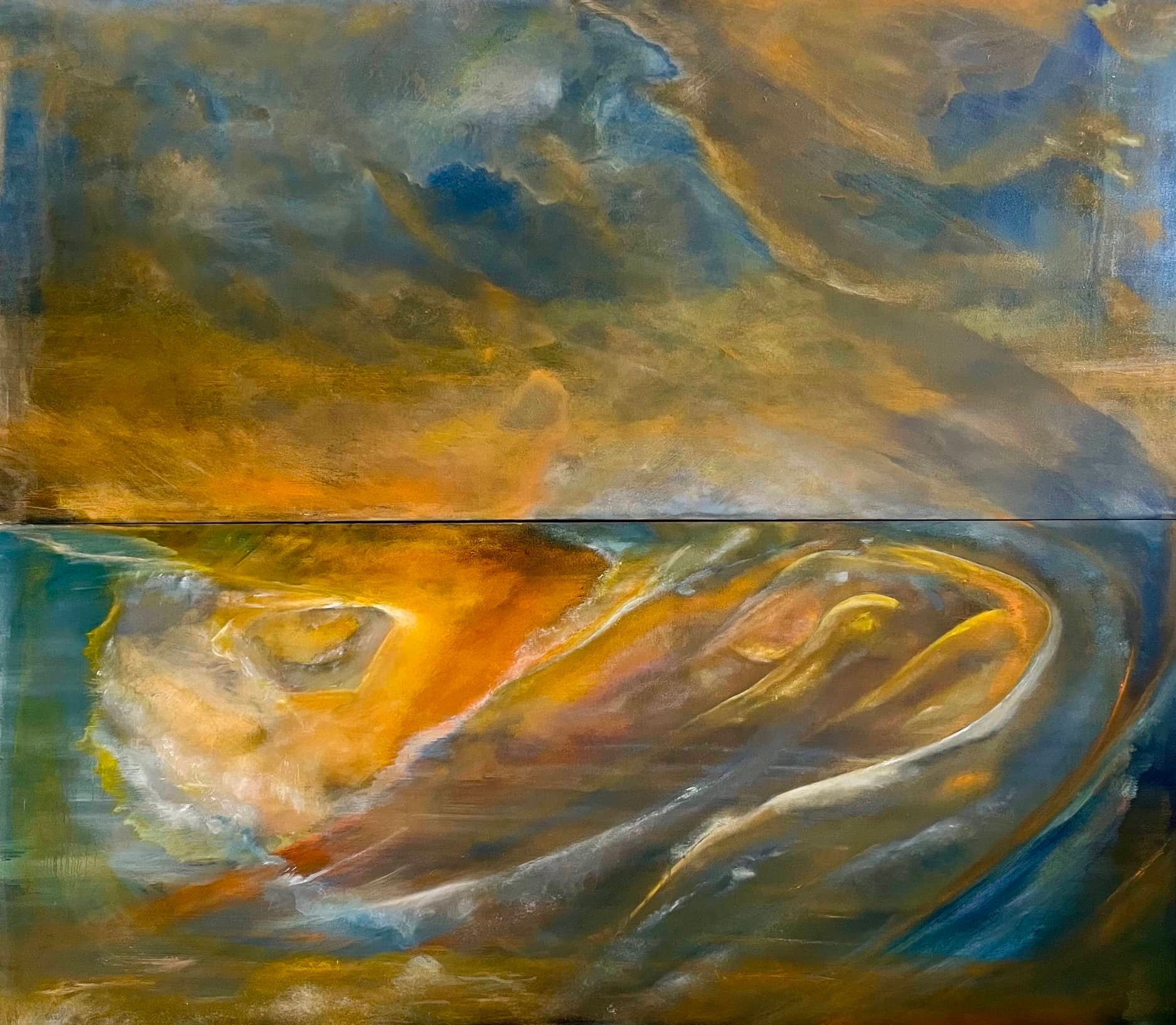
Orbiting the Invisible began as an idea, a thought about what might exist underneath the clouds or beneath the surface. Something just under the surface and something above. Something near the edge, almost visible.
Beneath the Surface
I work without preliminary sketches, allowing the painting to develop directly on the canvas. As suggestions of figures, light, and atmosphere began to appear, I followed them rather than trying to define them.
Shapes and lines emerged, disappeared, and returned as the painting changed. Some forms seem close to the surface, while others appear farther away. I wanted the painting to hold that feeling of something seen and something still hidden.
Building Light Through Layers of Oil Paint
I built the painting with multiple thin layers of professional-grade oil paint and medium. Each new layer changed what was already there. Some areas became more transparent, while others developed greater depth and texture.
Thousands of individual brushstrokes overlap throughout the painting. Color, lines, and shapes move across the two canvases, connecting one panel to the other.
At one point, I thought the painting was complete. However, when I looked at it again, I wanted more from it—more light and more color.
Paintings are visual, and I kept asking myself: How can I make it more visual?
So I continued painting.
I added more layers of color, allowing the light and atmosphere to change. New relationships developed between the figures, shapes, and surrounding space. Some forms became stronger, while others remained just beneath the surface.
That sense of something appearing and disappearing eventually became an important part of Orbiting the Invisible.
Two Canvases, One Abstract Painting
Orbiting the Invisible is a diptych—two individual canvases created to form one abstract oil painting.
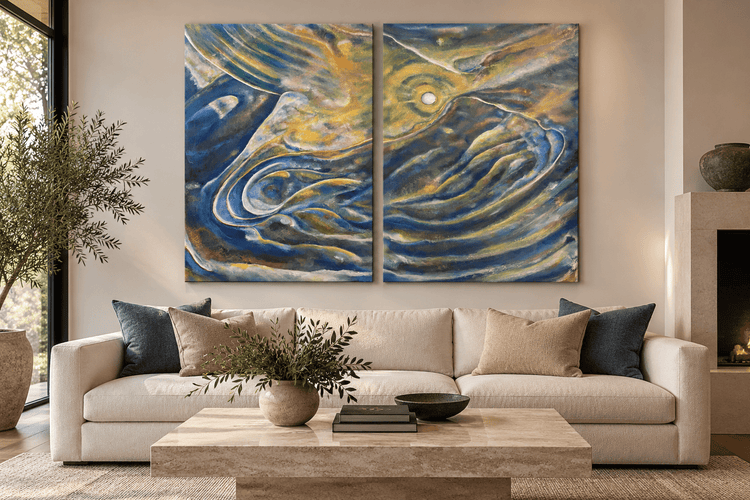
The brushstrokes, shapes, color, and movement continue from one canvas to the other. At the same time, the small space between the canvases becomes part of the composition. Changing that space can subtly change the relationship between the two panels.
This painting took several months to complete. Each canvas measures 29 × 40 inches and is oil on hand-stretched canvas.
About the Images
The photographs show the full two-canvas painting, a close-up detail of the surface and brushwork, an interior view for scale, and an interior view showing the canvases displayed with additional space between them.
Artwork details
- Original abstract oil painting
- Diptych / two-canvas artwork
- Each canvas: 29 × 40 inches
- Combined size: approximately 40 × 58 inches when displayed together
- Professional-grade oil paint on hand-stretched canvas
- Created over several months
- Painted without preliminary sketches
- Signed and dated on the back
- One-of-a-kind original artwork
Part 1 – Why I Create Two-Canvas Oil Paintings
Read Part 2: How My Abstract Diptych Paintings Developed
Description
Orbiting the Invisible – Original Abstract Oil Painting Diptych
Orbiting the Invisible began as an idea, a thought about what might exist underneath the clouds or beneath the surface. Something just under the surface and something above. Something near the edge, almost visible.
Beneath the Surface
I work without preliminary sketches, allowing the painting to develop directly on the canvas. As suggestions of figures, light, and atmosphere began to appear, I followed them rather than trying to define them.
Shapes and lines emerged, disappeared, and returned as the painting changed. Some forms seem close to the surface, while others appear farther away. I wanted the painting to hold that feeling of something seen and something still hidden.
Building Light Through Layers of Oil Paint
I built the painting with multiple thin layers of professional-grade oil paint and medium. Each new layer changed what was already there. Some areas became more transparent, while others developed greater depth and texture.
Thousands of individual brushstrokes overlap throughout the painting. Color, lines, and shapes move across the two canvases, connecting one panel to the other.
At one point, I thought the painting was complete. However, when I looked at it again, I wanted more from it—more light and more color.
Paintings are visual, and I kept asking myself: How can I make it more visual?
So I continued painting.
I added more layers of color, allowing the light and atmosphere to change. New relationships developed between the figures, shapes, and surrounding space. Some forms became stronger, while others remained just beneath the surface.
That sense of something appearing and disappearing eventually became an important part of Orbiting the Invisible.
Two Canvases, One Abstract Painting
Orbiting the Invisible is a diptych—two individual canvases created to form one abstract oil painting.
The brushstrokes, shapes, color, and movement continue from one canvas to the other. At the same time, the small space between the canvases becomes part of the composition. Changing that space can subtly change the relationship between the two panels.
This painting took several months to complete. Each canvas measures 29 × 40 inches and is oil on hand-stretched canvas.
About the Images
The photographs show the full two-canvas painting, a close-up detail of the surface and brushwork, an interior view for scale, and an interior view showing the canvases displayed with additional space between them.
Artwork details
- Original abstract oil painting
- Diptych / two-canvas artwork
- Each canvas: 29 × 40 inches
- Combined size: approximately 40 × 58 inches when displayed together
- Professional-grade oil paint on hand-stretched canvas
- Created over several months
- Painted without preliminary sketches
- Signed and dated on the back
- One-of-a-kind original artwork
Part 1 – Why I Create Two-Canvas Oil Paintings
Read Part 2: How My Abstract Diptych Paintings Developed
You May Also Like