
How My Abstract Diptych Paintings Developed – Part 2

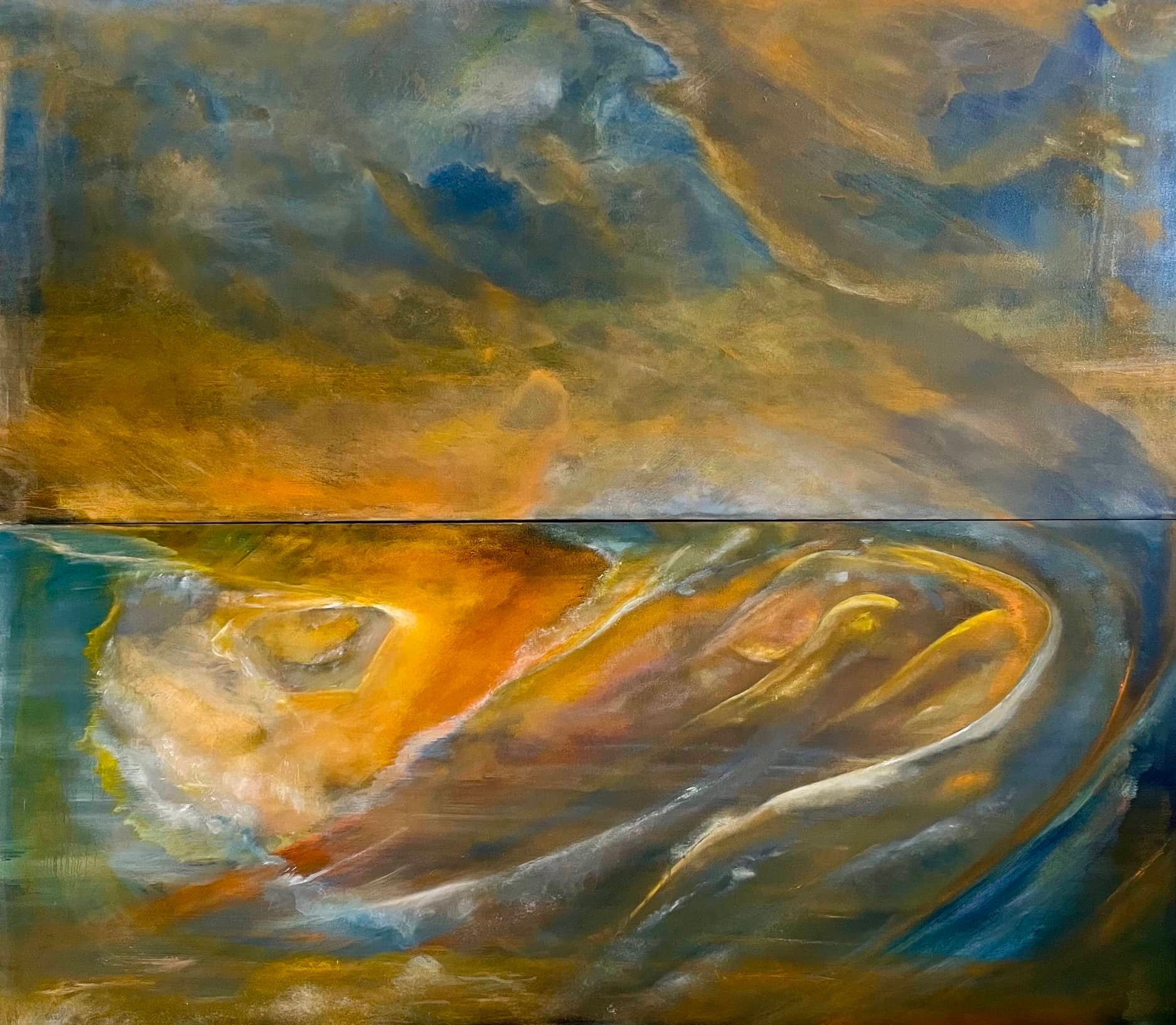
I have been creating abstract diptych paintings since the middle of my career. A diptych is an artwork made in two parts. In my work, those parts are two separate canvases that form one complete painting.
Earlier in my career, I worked mainly on large single canvases. I used bold colors, lines, shapes, and brushstrokes to divide the painted surface.
Over time, I began to wonder: What would happen if I physically separated a painting into two canvases? Could they still come together as one work of art?
Exploring Divided Space Through Photography
Part of my exploration began with black and white photography. I was fascinated by the way a photograph captures a single moment. However, I wanted to explore how cutting it into sections might change the way we see that moment.
In one experiment, I cut a photograph into nine rectangles. Each section became something I could view on its own while still seeing its connection to the whole.
This process led me to explore where one section ends and another begins. My eye connected forms across the gaps. Meanwhile, the space between the sections became part of the image.
The photograph shown here features a hand and arm lit by a strong light source. After dividing the photograph, I used the white of the paper itself as part of that light. As a result, the empty space became part of the image.
From Photographs to Abstract Diptych Paintings
These experiments changed the way I thought about painting. Instead of dividing a single canvas with a painted line or shape, I could work with the actual edges of two canvases.
The space between them could then become part of the composition. This idea gradually led to the two-canvas abstract oil paintings I continue to create today.
Although the canvases are separate, I paint them as one composition. Colors, lines, shapes, and brushstrokes connect them across the gap. Abstract and figurative forms may also move from one canvas to the other, guiding the eye across both surfaces.
Painting Beyond the Edges
For me, the separation is intentional. The edge of a canvas does not have to mark the end of an image. Instead, it can invite the eye to continue across the space to the next canvas.
Working this way allows me to explore both the painted surface and the space around it. Each canvas has its own presence, yet both contribute to the complete painting.
Today, abstract diptych paintings remain an important part of my work. Each is an original, one-of-a-kind oil painting that I create in my studio in Glen Allen, Virginia.
- Original abstract oil paintings on two canvases.
- Created as one unified composition.
- Connected through color, line, shape, and brushwork.
- Space between the canvases becomes part of the artwork.
- Each painting is one of a kind.
- Created in my studio in Glen Allen, Virginia.