

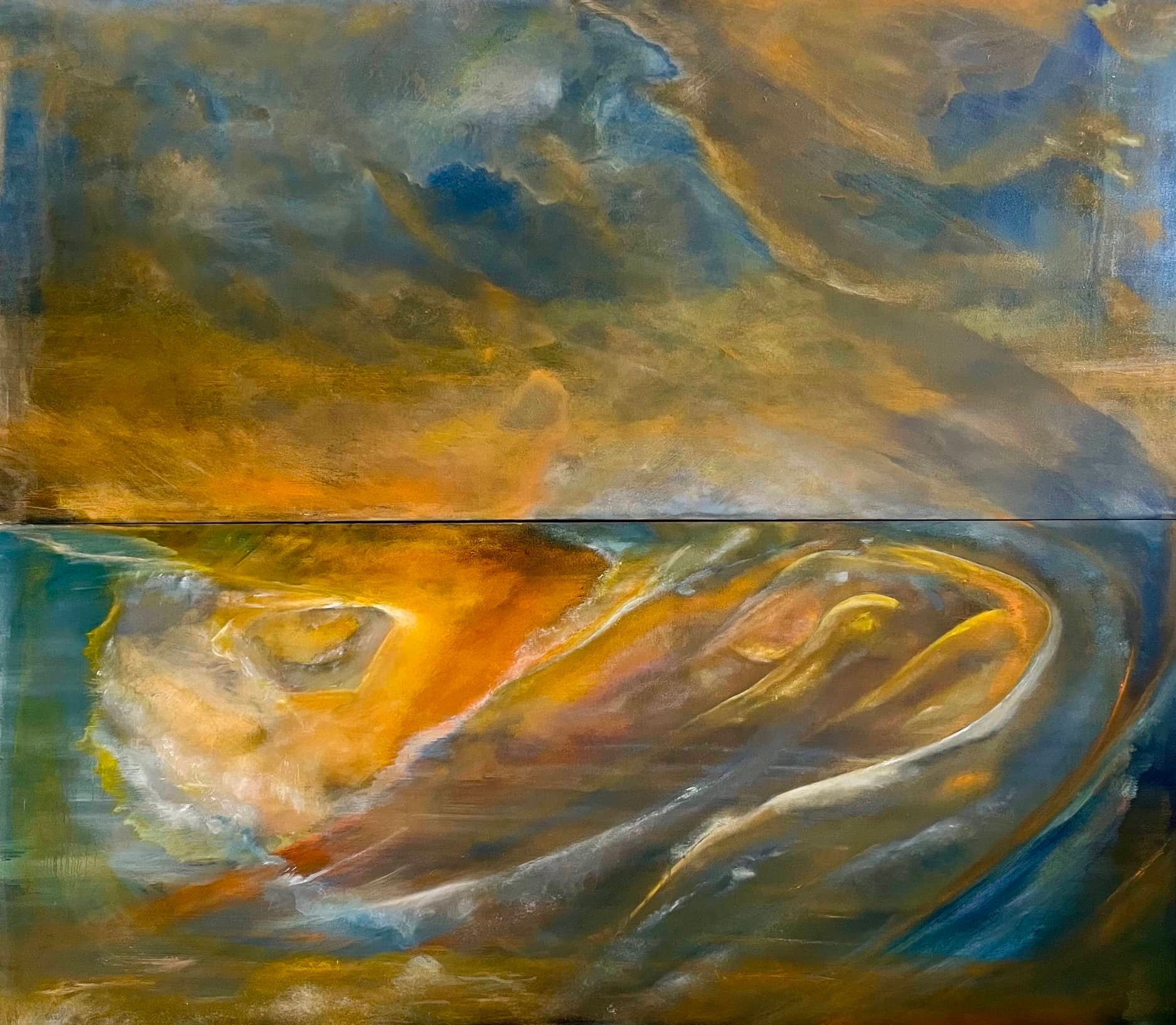
Laurie Rubell Two-canvas oil paintings

Two-canvas oil paintings
Why do I use two canvases to create one abstract oil painting?
I began exploring two-canvas oil paintings in the middle of my career. I wanted to see how color, lines, shapes, and imagery could move beyond the edges of a single canvas. As a result, working with two canvases opened a new way of thinking about painting.
Looking Beyond the Edges
As I painted across two canvases, I became interested in the space between them. The edges were no longer simply where the painting stopped. Instead, they became part of the composition.
How does the edge of one canvas relate to the other? Do the forms seem to pull toward each other or move apart?
For example, a large area of color can connect both canvases. A line might lead the eye toward the gap, then continue on the other side. Yet each canvas can also have its own identity while remaining part of the whole.
These questions continue to guide my work.
Two Canvases, One Painting
A painting made across two panels is called a diptych. Although the surfaces are separate, I paint them as one composition.
Color, brushstrokes, lines, and abstract forms help bring the two canvases together. However, the gap between them also plays a role. It creates a pause within the painting and allows the wall to become part of the viewing experience.
Moving the canvases closer together or farther apart changes that relationship. The eye travels differently across the forms, while the painted surfaces remain visually connected.
For me, exploring this balance is part of creating a two-canvas oil painting.
Painting and the Surrounding Space
My interest also extends beyond the canvases themselves. I think about how the painting relates to the wall and the room around it.
With a diptych, I can explore three kinds of space: the painted surfaces, the gap between the canvases, and the surrounding wall. Together, these shape how we experience the artwork.
This is why I continue to create two-canvas abstract oil paintings. They give me ways to explore edges, color, and movement that differ from working on a single canvas.
Ultimately, I see two separate canvases as one painting—one original work of art.
What I Explore in Two-Canvas Paintings
- Two separate canvases forming one composition
- Color, lines, and shapes that connect across the edges
- Space between the canvases as part of the artwork
- Changes in the visual relationship when the canvases move apart
- Connections between the painting and its surroundings
— Laurie Rubell